Use your phone number as a handout email address! Sounds simple, but I thought it was a no-brainer when I heard it! Use your number with a free Hotmail, Yahoo! or Gmail account.
Very little chance of it getting spammed, and you can remember it anywhere to scribble on a bar mat or napkin!
Owning a Tourism Business is awesome

4 May 2007


3 May 2007
Search Engine Marketing Strategy - Give People a Reason to Link to Your Website
Search Engine Marketing Strategy - Give People a Reason to Link to Your Website: "Search Engine Marketing Strategy - Give People a Reason to Link to Your Website
It is essential to establish quality inbound links from websites with high page ranks to attain a high ranking amongst search engines. The 20 guidelines listed below should be followed diligently.
1. Develop content related to your site with links on all pages. Offer other websites to post it on their sites free of cost. This will expose you more to your target audiences.
2. Permit other websites to publish your beneficial review of their business if they link up to your website.
3. Include your websites ad and link in every issue of your e-zine. Allow other sites to publish your e-zine on their site.
4. Let other sites give away free web book designed with your website title and contents on linking to your website.
5. Place a banner ad on the top of the article directory for your website. By linking to your site, visitors can add a free article directory to their site.
6. Allow other sites to use your discussion board by linking. Add your banner ad on top of discussion board.
7. Offer free membership to your 'members only' websites.
8. Pay commission to visitors to sell your product or services, and an affiliate link to track their sales.
Read more here:
Search Engine Marketing Strategy - Give People a Reason to Link to Your Website
It is essential to establish quality inbound links from websites with high page ranks to attain a high ranking amongst search engines. The 20 guidelines listed below should be followed diligently.
1. Develop content related to your site with links on all pages. Offer other websites to post it on their sites free of cost. This will expose you more to your target audiences.
2. Permit other websites to publish your beneficial review of their business if they link up to your website.
3. Include your websites ad and link in every issue of your e-zine. Allow other sites to publish your e-zine on their site.
4. Let other sites give away free web book designed with your website title and contents on linking to your website.
5. Place a banner ad on the top of the article directory for your website. By linking to your site, visitors can add a free article directory to their site.
6. Allow other sites to use your discussion board by linking. Add your banner ad on top of discussion board.
7. Offer free membership to your 'members only' websites.
8. Pay commission to visitors to sell your product or services, and an affiliate link to track their sales.
Read more here:
Search Engine Marketing Strategy - Give People a Reason to Link to Your Website
US Online Travel: The Threat of Commoditization
It is still far from a tailspin, but the US online travel industry is undergoing a revolution that is redefining the rules of engagement between travel firms and their customers. Internet-savvy consumers are exploiting powerful online resources to find new travel products and pricing options.

eMarketer Reports—On-Target and Up-to-Date
The US Online Travel report analyzes the progress of this still growing, but slowing, bellwether Internet sector.
The good news: eMarketer estimates that online consumer travel sales hit $79 billion in 2006 and will grow at a 17% annual rate before reaching $146 billion in 2010. While that is respectable growth, it falls short of the 28% annual growth rate posted from 2002 to 2006.
The bad news: A tighter market will exacerbate the fierce competition between online travel agencies and travel suppliers in an already commoditized market.
eMarketer Reports—On-Target and Up-to-Date
The US Online Travel report aggregates the latest data from a wide range of marketing and communications researchers with eMarketer numbers, projections and analysis to provide the information you need to make the right business decisions.
How to Keep Keep Your Computer Virus-free
We have just had a very bad week here in Fiji with viruses and Trojans running riot through organizations networks. It appears that we are getting on average 10 emails each a day with threats attached. In light of this I have assembled a run down of what you should have in regards to Anti-Virus software. (we will address spy ware and Trojans specifically later).
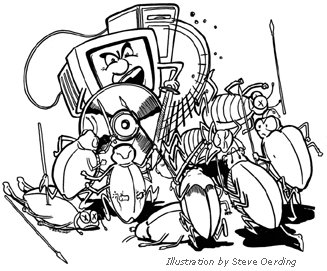
It sounds amazing but somewhere out there in the world are malicious programmers working to dream up new computer viruses and the likes. Eugene Kaspersky, (of Kaspersky Lab Virus Research), in a November 23, 2005 article posted in Security News, said, "The number of new viruses and Trojans is now increasing every day by a few hundred. (Our) virus lab receives between 200 and 300 new samples a day."

The few really bad ones we all get to hear about. The majority are quiet and anonymous like white ants, often doing much damage before they are detected. Like biological viruses, their effects run the spectrum from mostly benign to potentially terminal to their unwilling and unknowing hosts. Also as in biological viruses, there are essentially two different approaches to dealing with them:
- Prevention
- Cure
Prevention
Preventing a virus infection begins with guarding all the portals of contact.
Never open suspicious e-mails or attachments without scanning them first.
Damn near all anti-virus programs have a right-click option to scan for viruses, which makes scanning too easy to not do. Similarly, when you download software, eBooks or ANYTHING, always save to a file, then scan the file before opening. If you bring in data or software by USB Keytag, CD or other portable media, the same rule applies; scan it first! Do it manually to be sure.
 A good firewall (ZoneAlarm is the one I use) can help somewhat in keeping viruses at bay, but there are too many ways to hide them in regular data or software transfers for a firewall to catch all of them. A firewall can help, but don't rely on that alone.
Cures
Benjamin Franklin once said, "An ounce of prevention is worth a pound of cure." However, sooner or later, some viruses are going to get through your defenses somehow, and you will need to turn to cures.

If you should somehow get infected by a really bad virus, you could lose most of your files before you know that there is a problem! The first step to enable cures is to prepare well in advance, positioning and backing up your files for easy recovery.

If you should somehow get infected by a really bad virus, you could lose most of your files before you know that there is a problem! The first step to enable cures is to prepare well in advance, positioning and backing up your files for easy recovery.
Set up your computer with another small hard drive (10-40GB) for your C: drive and a much larger hard drive for all your data. My advice is to use your C: drive for programs only. Set up another say D: drive for all your data.
Keep copies of your software purchases, their receipts, registration and activation codes and setup info in a file on your data drive, D:. You can always download the software again, if you can give the seller your purchase info to show that you already bought it.
Almost all virus infections will be in the program section of the C: drive, so scan it daily. All anti-virus program will allow you to shedule this at some time during the day. This won't take much time since you have arranged for it to be relatively small. I do mine in the morning first thing. I turn on my PC, let AVG do its thing while I make a cup of coffee. It takes 7 minutes for me (and I have a LOT of programs).
Almost all virus infections will be in the program section of the C: drive, so scan it daily. All anti-virus program will allow you to shedule this at some time during the day. This won't take much time since you have arranged for it to be relatively small. I do mine in the morning first thing. I turn on my PC, let AVG do its thing while I make a cup of coffee. It takes 7 minutes for me (and I have a LOT of programs).
Scan your (larger) data drive, D:, once or twice a week. Again schedule this for a time when you won't be there.
You should still back up your data files frequently. If you cannot backup everything, at least backup the crucial information that would be difficult or impossible to replace. The simplest way is to have a removable hard drive. As this is only gogin to hold data files, it is unlikely to harbour nasty viruses (but not impossible). CD and DVD burners are another good way to do this backup. Because of a couple of bad hits we've had in the past 10 years I do both! (And the DVD-R backups are stored at a friend's house incase we have an office fire)
Finally, you will need a good anti-virus program to go after the viruses and either quarantine or (preferably) destroy them. There are many anti-virus solutions being touted and hyped out there. Some are good, most are not. Here is how to find the good ones:
1. Look for programs that offer both active and passive protection.
Active protection means that part of the program remains memory-resident, actively watching for potential incoming viruses. When they detect a virus they can sound an alarm and give you a series of options for dealing with it. Passive or on-demand protection will let you ask for a scan of specified areas when you want it, but it waits for you to ask.
2. Select your anti-virus software based on the recommendations of independent testing agencies.
Checkmark (by westcoastlabs.org), AV-test.org and PC World magazine are among the most respected independent testers of anti-virus software. For ratings of anti-trojan software, check with Anti-trojan - Forum. Use more than one anti-virus and anti-trojan program. Very few detect all problems, but what one program misses, another may find and defeat.
3. Keep your anti-virus programs up to date.
There is a running gun battle going on between virus writer-disseminators and virus catch-and-destroy experts. New viruses are found; new anti-virus program patches to find and destroy them are usually ready within hours or days. Until your software is updated, you are still vulnerable to the new viruses.
In addition to using anti-virus software on your personal computer, consider using an Internet Service Provider (ISP) or e-mail service that includes server-side anti-virus and spam e-mail filtering as a third layer of protection.
Finally, be careful, get good software, run it often and update it frequently... and stay alert to new developments! This struggle between new viruses and better anti-virus software is ongoing, developing rapidly and will NEVER end!
You should still back up your data files frequently. If you cannot backup everything, at least backup the crucial information that would be difficult or impossible to replace. The simplest way is to have a removable hard drive. As this is only gogin to hold data files, it is unlikely to harbour nasty viruses (but not impossible). CD and DVD burners are another good way to do this backup. Because of a couple of bad hits we've had in the past 10 years I do both! (And the DVD-R backups are stored at a friend's house incase we have an office fire)
Finally, you will need a good anti-virus program to go after the viruses and either quarantine or (preferably) destroy them. There are many anti-virus solutions being touted and hyped out there. Some are good, most are not. Here is how to find the good ones:
1. Look for programs that offer both active and passive protection.
Active protection means that part of the program remains memory-resident, actively watching for potential incoming viruses. When they detect a virus they can sound an alarm and give you a series of options for dealing with it. Passive or on-demand protection will let you ask for a scan of specified areas when you want it, but it waits for you to ask.
2. Select your anti-virus software based on the recommendations of independent testing agencies.
Checkmark (by westcoastlabs.org), AV-test.org and PC World magazine are among the most respected independent testers of anti-virus software. For ratings of anti-trojan software, check with Anti-trojan - Forum. Use more than one anti-virus and anti-trojan program. Very few detect all problems, but what one program misses, another may find and defeat.
3. Keep your anti-virus programs up to date.
There is a running gun battle going on between virus writer-disseminators and virus catch-and-destroy experts. New viruses are found; new anti-virus program patches to find and destroy them are usually ready within hours or days. Until your software is updated, you are still vulnerable to the new viruses.
In addition to using anti-virus software on your personal computer, consider using an Internet Service Provider (ISP) or e-mail service that includes server-side anti-virus and spam e-mail filtering as a third layer of protection.
Finally, be careful, get good software, run it often and update it frequently... and stay alert to new developments! This struggle between new viruses and better anti-virus software is ongoing, developing rapidly and will NEVER end!
2 May 2007
What is PPC (Pay Per Click) and What It Costs

Search keyword marketing is paid for on the basis of how many people click on your ad, so it's called pay per click.
There are other advertising methods as well: CPL (or cost per lead), where you pay for each "lead" or potential customer you get from the ad, see InfoHub.com for travel site that does this well; and CPA (cost per action), with the action taken by the customer being defined variously as filling out a form or signing up for something. There is also revenue sharing, where the site carrying the ads gets a cut of any purchases made as a result of the ads.
An interesting variant on cost per click is cost per call, a service offered by Yahoo! and AOL that is particularly interesting for very local businesses. In this case, you list not your Web link, but your phone number, and Yahoo! and AOL track the calls you receive through that ad. Obviously, it's also handy for businesses that don't have a Web site at all. How cool is that?
OK, so you pay a cost per click — but what is the cost per click?
Well, that depends on what you're willing to pay, in competition with others. In this market, you are buying the right to have your ad displayed on the search results page generated when somebody has typed a particular keyword or search term into the search engine. Somebody searches on the phrase "life insurance" and, since you sell life insurance, you want your ad to pop up there. So you bid on the term "life insurance" and what you pay depends on what everybody else is bidding.
The minimum bid on Google is 10 cents. On Yahoo! it's 5 cents, but you'll only pay that amount for obscure terms that nobody else wants. Other terms are more expensive — sometimes breathtakingly more expensive: "Delaware incorporation services," for example, costs about $8 per click. The term "merchant accounts" is running about $6 per click at the time of this writing. Certain legal terms and medical terms, linked with diseases that are subjects of class-action lawsuits, can cost as much as $30 per click.
Quite a range! Although none of the major search engines publish averages, the sense of the industry seems to be that typical keyword buyers are paying between a dime and a couple of bucks per click.
Fortunately, you have a lot of control over what you pay. When you bid on keywords, you get a lot of information from Google and Yahoo! about what others are bidding, so you're not bidding blind. You can see which keywords are popular with searchers and which are popular with buyers, and plan accordingly. And of course you can tinker with your keyword purchases to find the best blend of price, response, and final results.
The 6 Most Common Reasons Why Web Sites Fail
1. Capturing Info.
The first and most biggest reason why Internet marketing web sites fail is because they fail to capture the name and email address of their visitors. On even the best sites 95% - 98% of all visitors will not initially buy your product.
To help higher your conversion it is mandatory that you collect the names and email addresses of your visitors. To do this simply put an opt in page or pop up that will ask your visitors to join you mailing list or ezine list. To help persuade them into doing this offer an e-book or e-course that is relevant to the subject you are discussing. Now you can continually market to these potential customers when ever you feel like it.
2. Poor Product Selection.
The second reason many internet marketing web sites fail is because they are selling a product that nobody is interested in or has a very low demand. Often times the products maker will tend to think they are the customer. Just because the creator is interested in the product does not mean that others are willing to pay for it.
Before any product is made some tests should be done to see if there is any demand for the product. To do this you can simply go to Goggle and type in the subject and see if anyone is using the PPC ads on the right to promote a similar or related product. In the Internet marketing world some competition is good.
If you know that others are making money in your niche you can bet that people will be willing to buy your product as well. Another thing you can do is start a blog and simply give people a poll or even better yet have them join your list so you can communicate with them directly.
3. Lack of Objective.
The third reason most internet marketing web sites fail is because the site does not have a clean and clear objective. So many direct response marketing sites are loaded with mistakes in the design. To help make your site more efficient take a look at one that you know is. See what they are doing different and make adjustments to your site. Once you have tested all you have to do is add more traffic.
4. Plain
The fourth reason most internet marketing web sites fail is because they don't stand out. Your site will have to grab the attention of your visitors. You generally have about ten seconds to do this. If you cannot get them interested that quickly you will most likely loose them forever.
One test you can do is this. Load up your site. Now load up your competitors. What instantly grabs your attention on their marketing web site? Now take this information and try to do something similar on yours. It is vital that you site stands out and grabs the reader by the eyeballs and sucks them right in. Making your internet marketing web site stand out is vital above the fold. Focus on that first part of your page and then the rest will start falling into place.
5. No Traffic
The fifth reason why most internet marketing web sites fail is due to lack of traffic. We really won't go into much detail on this one since it is a very large subject. Some of the things you can do to get free traffic are to write site relevant articles and submit them to the article directories and write site relevant press releases about products in your niche as well as your site.
If you are willing to spend a few dollars to get your internet marketing site some traffic you can try your luck at PPC. Your best bet is using Google AdWords. This may cost you a little due to the saturation that Google has in most of its keywords. Another alternative may be to use several lesser known PPC sites to try and achieve the same effect.
6. Sales Copy
The sixth and final reason why many internet marketing web sites fail is because of their sales copy. Copy writing is an art. If you are not a fairly experienced copywriter or good with words by all means don't try and write your own copy.
A professional copywriter may end up costing you thousands of dollars but if you know that your product will sell you are much better off going this route. If you do not know what you are doing you may spend weeks if not months testing and tweaking your copy until it sells well. If this is the case I strongly suggest reading a book or two on the subject.
So there you have it, the six most common things that will cause your internet marketing web site to fail. If you take the time to avoid these mistakes you will be leaps and bounds ahead of most others. It sure is not easy to get your page running to its best potential but the rewards are sure worth it.
1 May 2007
BFTE 2007: Putting together a good Marketing Kit

The typical resort brochure doesn't demonstrate how your business is different - create a suite of education based materials and stand out from the competition.
I get these calls from time to time, especially on the lead up to shows such as BFTE in 2 weeks . . ."Can you make me a brochure?" Many resort and dive centre owners have been sold on the notion that they need a tri-fold brochure or they are not in the tourism business. Forget it... everybody's got one and no one uses it. No not even the racks in the Rosie's Office in Nadi Airport!
Your potential guests and buyers need an education. They need to know how you are different. (the normal tri-fold brochure simply confirms that you are the same!)
Every small tourism business should create the following pieces of information and format them in a way that allows them be printed inexpensively and updated often. I like to call this approach, the Marketing Kit. Your marketing kit starts with several professionally printed pieces that are the basis for up to 12 or 15 different educational documents. The core components are:
1. A pocket folder - A multi-use workhorse, this piece alone, if designed well, can send the message that you are in business to stay. (This one will cost a little but it has many uses). Get it professionally printed, and not just a Acco black one with a stuck on label. If they are too pricy print fewer quantity not poorer quality!
2. A marketing template - This should be a professionally printed piece that carries your business logo and contact information but is different than your letterhead. This is the base piece then for the following pages that insert into your pocket folder. Your actual marketing files can be WORD or OpenOffice type documents that are printed. This gives you the ability to change and update your content and also allows you to tailor your marketing kit to specific prospects, shows and buyers.
A combination of the following should be created for your marketing kit.
The Difference Page - Tell your guests and buyers how you are different and shower them with benefits (not features!) of doing business with you. Don't tell them what you do. I like to keep this one to the top 3 or 4 things that you do that your target market will value. Think benefits that are unique...
A list of products and services - Okay, now tell them what you do or what amenities and features you offer at your operation, but make sure to do it the context of how they can benefit from your operation. Talk about how "you can sit next to the great pool" not that "we have a great pool".
Testimonials - Get quotes from real live guests and travel buyers and create a page titled - "See what others have to say about us." These quotes can be some of the strongest selling tools you have. New technologies make it easy to create audio and video testimonials too, and distribute on YouTube and as podcasts.
Your Story - Many resorts, cruise ships and dive/tour operations have interesting or even gut wrenching histories. Tell them your story in an open, honest, and entertaining way and you will win their hearts as well as their heads. Post cyclone recovery stories are actually great reading and add character to your story!
FAQs - Compile a list of the questions your prospects and guests ask most often (don't forget the ones they never ask, but should) and answer them on this page.
Ideal Client Description - In some cases a page that describes the type of person or travel buyer that you can help the most can allow a prospect to select or deselect themselves.
There are other pages that may or may not make sense for your particular tourism business situation and the kit can and should be constantly grown and updated as you gather more guests and travel buyers and refine your core messages.
After you complete your kit you may wonder if anyone will actually read all of that information. Probably not everyone, but many will skim and find what they were looking for as people learn in many different ways. Your kit allows them to read the same message, essentially, packaged in a number of formats.
All of the above pieces can, in many cases, be word processed files that are easily printed onto the template described above. This format allows for very inexpensive printing and a great deal of flexibility when you need to update, change and personalise your marketing materials.
Your marketing kit is not meant to be used as something your send out to a list of suspects, it is your lead conversion tool to be used ahead of or after a lead or referral asks for more information.
Fiji Islands on Squidoo
I just started to play with Squiddo, a heck of a lot of fun and it's building links from relevant content like crazy. Have a go!
Fiji Islands on Squidoo

Fiji Islands on Squidoo
The Best Performing Online Advertising Survey

According to a survey from MarketingSherpa.com, which I have found interesting, the best performing online advertising (great ROI) tactics of 2006 were:
1. Paid search ads
2. E-mail lists (in house)
3. Search engine optimization
Full study at eMarketer.
I would say that one should use as only the advertising campaigns that you can qualify as covering a good ROI rather than just to get better hold on the Internet.
Subscribe to:
Posts (Atom)